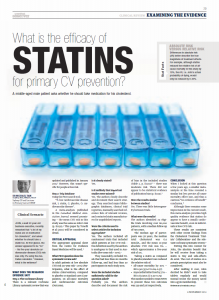
 This article was published in Medical Observer.
The article is also available on the Medical Observer website (may need registration).

Nov 08 2013
This article was published in Medical Observer.
The article is also available on the Medical Observer website (may need registration).
Nov 06 2013
 Presentation titled “Common medical myths! And evidence-based health care” delivered at the Wolper Jewish Hospital, Wellbeing Program.
This was held at Cinema 9, Event Cinemas, Westfields, Bondi Junction, on 6 November 2013 at 1930.
The Powerpoint of the presentation can be downloaded by clicking here.
A transcript can be provided on request.
Nov 04 2013
This was a comment to the online article, “Viewing Catalyst’s cholesterol programs through the sceptometer“, written by Dr Justin Coleman, published on The Conversation on 4 November 2013. This was an interesting perspective offered by a clinical general practitioner following the rather problematic Catalyst program on cholesterol and statins.
Great article Justin!
I agree with most of your points, but as per Prof Clifton’s comment, the accumulated evidence has moved on somewhat from the meta-analysis from 2010. Newer systematic reviews and meta-analyses on the question of the effectiveness of statins in primary prevention have generally found some mortality and cardiovascular benefit. For instance, in a short piece for Medical Observer published last Friday, I looked at a meta-analysis from 2011 specifically in patients at low absolute CVD risk: https://vitualis.com/?p=505 Effectively, the magnitude of the effect is about the same as that found in the Ray et al. (2010) meta-analysis, but with narrower confidence intervals that no longer includes no-effect. Prof Clifton already quotes the 2013 update of the Cochrane systematic review which demonstrates a similar result. Continue reading
Nov 04 2013
This article was original published in The Conversation.
By Michael Tam
When I was in my teens, I watched the comedy Crazy People, starring Dudley Moore and Daryl Hannah. Moore plays a burnt-out advertising executive who creates (hilarious) “honest” ads. One of the ads is for the fibre supplement Metamucil which claims:
It helps you go to the toilet. If you don’t use it, you’ll get cancer and die.
Oct 19 2013
This presentation was presented at the 2013 RACGP GP13 Convention in Darwin, 17-19 October 2013.
Authors:
YouTube video presentation:
Nov 14 2013
Comment: To statin or not to statin?
The following is a comment to the online article, “To Statin or not to Statin? – That is the question” by Dr Robin Park. This article is a very readable summary of a number of practical questions about statins for GPs.
Great summary Rob!
A few comments… The evidence for the benefit of LFT and CK monitoring for statins is poor, and the rationale for doing so is questionable in light of the accumulated safety data for statins. An argument can perhaps be made for baseline LFT (even in otherwise fit and well people), but the utility of a baseline CK is rather low in someone not at high risk of myopathy. Stopping a statin in someone who is at mod/high CVD risk, due to an asymptomatic rise in CK, probably does more harm than good. Continue reading